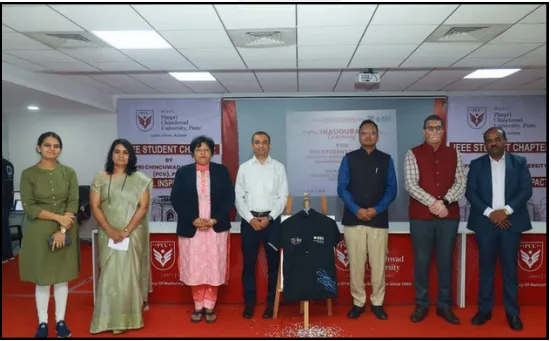
IEEE Student Chapter Inaugural Ceremony
INNOVARE: Inspiring Innovation and Engineering Excellence marked the beginning of an exciting journey for IEEE student members at PCU...
Read MoreThe School of Engineering & Technology at Pimpri Chinchwad University is committed to delivering world-class education through a perfect blend of academic excellence, industry exposure, and research-driven learning.
Our programs are designed to nurture innovation, problem-solving skills, and ethical values, preparing students for global engineering challenges.
To be recognized as a center of excellence producing high-quality professionals in the field of , committed to lifelong learning, innovation, and service to society
The following Program Outcomes describe the knowledge, skills, and attitudes expected of graduates upon completion of the program.
PO1: Engineering Knowledge – Apply the knowledge of mathematics, science, engineering fundamentals, and an engineering specialization to the solution of complex engineering problems.
PO2: Problem Analysis – Identify, formulate, review research literature, and analyze complex engineering problems reaching substantiated conclusions using first principles of mathematics, natural sciences, and engineering sciences.
PO3: Design / Development of Solutions – Design solutions for complex engineering problems and design system components or processes that meet the specified needs with appropriate consideration for the public health and safety, and the cultural, societal, and environmental considerations.
PO4: Conduct Investigations of Complex Problems – Use research-based knowledge and research methods including design of experiments, analysis and interpretation of data, and synthesis of the information to provide valid conclusions.
PO5: Modern Tool Usage – Create, select, and apply appropriate techniques, resources, and modern engineering and IT tools including prediction and modeling to complex engineering activities with an understanding of the limitations.
PO6: The Engineer and Society – Apply reasoning informed by the contextual knowledge to assess societal, health, safety, legal and cultural issues and the consequent responsibilities relevant to the professional engineering practice.
PO7: Environment and Sustainability – Understand the impact of the professional engineering solutions in societal and environmental contexts, and demonstrate the knowledge of, and need for sustainable development.
PO8: Ethics – Apply ethical principles and commit to professional ethics and responsibilities and norms of the engineering practice.
PO9: Individual and Team Work – Function effectively as an individual, and as a member or leader in diverse teams, and in multidisciplinary settings.
PO10: Communication – Communicate effectively on complex engineering activities with the engineering community and with society at large, such as, being able to comprehend and write effective reports and design documentation, make effective presentations, and give and receive clear instructions.
PO11: Project Management and Finance – Demonstrate knowledge and understanding of the engineering and management principles and apply these to one's own work, as a member and leader in a team, to manage projects and in multidisciplinary environments.
PO12: Life-long Learning – Recognize the need for, and have the preparation and ability to engage in independent and life-long learning in the broadest context of technological change.

Industry-Oriented Curriculum Aligned with emerging domains such as Artificial Intelligence, Machine Learning, Deep Learning, Data Science, and Computer Vision.
01
Hands-on Learning Ecosystem Project-based learning, lab-intensive courses, real-time problem solving, and case studies.
02
Early & Global Industry Exposure Internship opportunities from Second Year (SY) onwards, including international internships (student interned in Malaysia).
03
Samsung Innovation Initiative Samsung Innovation programs and labs fostering advanced technical skills, innovation, and industry-relevant training.
04
Strong Programming & Tool Proficiency Expertise in Python, Java, C++, data analytics frameworks, and AI development tools.
05
Research, Innovation & Competitions Active participation in hackathons, research publications, national-level project competitions, and technical events.
06
Skill Enhancement & Certifications Learning through MOOCs, cloud platforms, and industry-recognized certification programs.
07
Interdisciplinary Application Focus Application of AI & Data Science in healthcare, finance, IoT, automation, and image processing.
08Download the detailed curriculum structure and program brochure of the School of Engineering & Technology.
Comprehensive syllabus outlining semester-wise subjects, credits, learning outcomes, and assessment structure.
Download SyllabusDetailed brochure covering program highlights, infrastructure, faculty, industry partnerships, and career opportunities.
Download BrochureMultidisciplinary Minor details coming soon.
Audit Courses details coming soon.
We maintain strong partnerships with leading technology organizations to provide students with real-world exposure, industry-aligned learning, and enhanced career readiness.






INNOVARE: Inspiring Innovation and Engineering Excellence marked the beginning of an exciting journey for IEEE student members at PCU...
Read More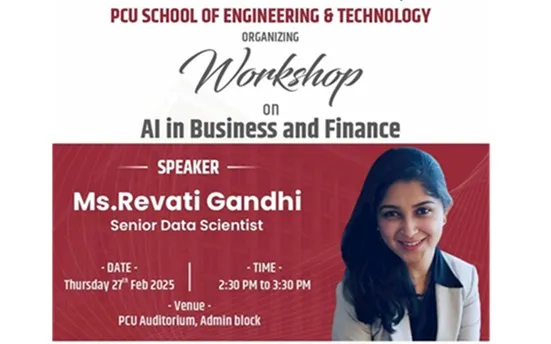
The Department of Computer Science & Engineering, PCU, successfully organized a collaborative academic and innovation-driven initiative...
Read More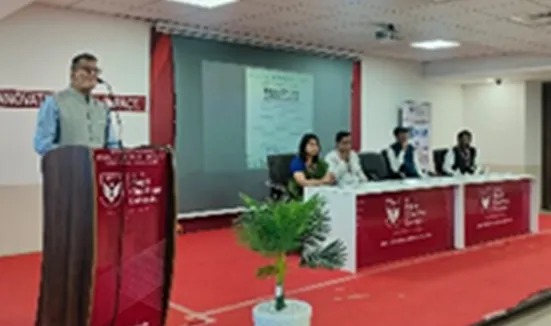
The Student Induction Program welcomed and oriented the newly admitted students for the academic year 2025–26 with expert interactions...
Read More
The AI specialization program provided me with both theoretical knowledge and practical skills. The faculty members are supportive and the projects helped me secure an internship at a leading tech company.
The Data Science curriculum is well-designed with a perfect balance of theory and hands-on practice. The industry projects gave me confidence to solve real-world data problems.
The AI specialization program provided me with both theoretical knowledge and practical skills. The faculty members are supportive and the projects helped me secure an internship at a leading tech company